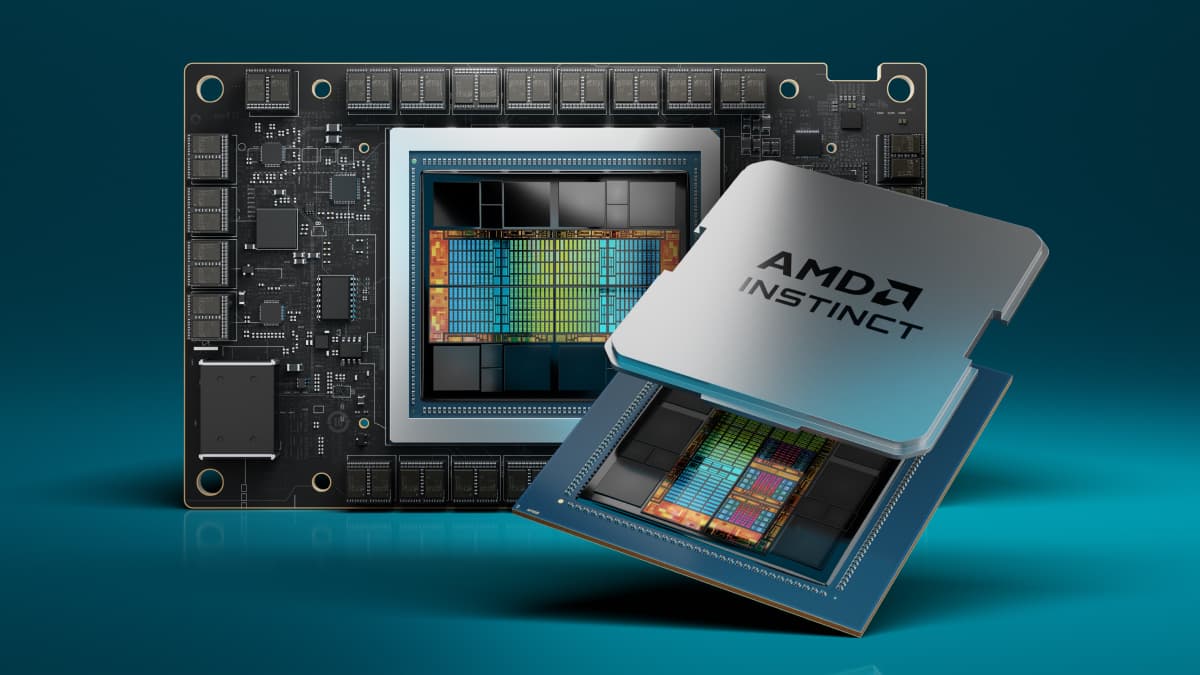
NVIDIA has owned the AI GPU market for a decade. But AMD's MI300X is finally a legitimate competitor—and it's 50% cheaper than H100.
Here's why MI300X matters, where it falls short, and when you should actually consider buying it.
The MI300X Pitch: More Memory, Less Money
What AMD Got Right
192GB HBM3 memory - That's 2.4x the H100's 80GB. You can fit:
- Llama 3 70B with full context (128K tokens)
- Multi-modal models without memory swapping
- Larger batch sizes for faster training
5.3 TB/s bandwidth - Faster than H100's 3 TB/s. Memory-bound workloads (like LLM inference) love this.
$29,999 pricing - H100 is $30K-$33K. MI300X undercuts by $3K-$5K. At scale (32+ GPUs), that's $100K-$160K saved.
OCP OAM form factor - Open standard, not proprietary like SXM. More vendor choice for servers.
What AMD Messed Up
ROCm ecosystem - Still immature compared to CUDA. Expect library bugs and missing features.
Software support - PyTorch/TensorFlow work, but optimization is 12-18 months behind NVIDIA.
Availability - "In stock" means 4-6 week lead times. H100 ships in 2 weeks.
No Transformer Engine - NVIDIA's FP8 magic doesn't exist on MI300X. You're stuck with standard FP16.
Performance: Where MI300X Wins (and Loses)
LLM Inference (MI300X's Sweet Spot)
Inference is memory-bandwidth-bound. MI300X's 5.3 TB/s shines here:
| GPU | Tokens/sec (Llama 2 70B) | Cost per 1M tokens |
|---|---|---|
| H100 80GB | ~1,800 | $1.20 |
| MI300X 192GB | ~2,100 | $0.90 |
| H200 141GB | ~2,300 | $1.10 |
Winner: MI300X for cost-per-token. H200 for raw speed.
Real Talk: The 15% performance difference doesn't justify a 30% price premium. MI300X is the smart inference buy.
LLM Training (H100 Still Wins)
Training is compute-bound. H100's Tensor Cores + Transformer Engine dominate:
| GPU | Training Time (Llama 3 8B, 1T tokens) | Utilization |
|---|---|---|
| H100 80GB | 7 days | 55% |
| MI300X 192GB | 10 days | 45% |
Why H100 wins:
- FP8 Transformer Engine (2x speedup on compatible models)
- Better PyTorch optimizations
- Mature NCCL library for multi-GPU
Why MI300X loses:
- ROCm's RCCL isn't as optimized
- No FP8 support yet
- Framework tuning lags 6-12 months
Verdict: For training, H100 is still king. MI300X is "good enough" if budget matters.
Computer Vision & Image Generation
| Workload | H100 | MI300X | Winner |
|---|---|---|---|
| Stable Diffusion XL | 1.2 img/sec | 0.9 img/sec | H100 |
| SAM (Segment Anything) | 45 FPS | 38 FPS | H100 |
| YOLO v8 | 320 FPS | 290 FPS | H100 |
Pattern: H100 is 10-20% faster on vision workloads. Not a huge gap, but consistent.
Software: CUDA vs ROCm in 2025
CUDA Ecosystem (NVIDIA)
Mature: 15 years of development Framework Support: PyTorch, TensorFlow, JAX all optimized Libraries: cuDNN, cuBLAS, NCCL are battle-tested Community: Every AI engineer knows CUDA
Verdict: It just works. No surprises.
ROCm Ecosystem (AMD)
Improving: ROCm 6.0 (late 2024) fixed major bugs Framework Support: PyTorch 2.x works well, TensorFlow has gaps Libraries: RCCL improving but still behind NCCL Community: Smaller, but growing
Pain Points:
- Some PyTorch ops don't have ROCm kernels (fallback to CPU)
- Triton kernels need porting (not automatic)
- HuggingFace Transformers have ROCm quirks
Verdict: Works for 80% of cases. The other 20% is painful.
HuggingFace Compatibility
| Library | H100 (CUDA) | MI300X (ROCm) |
|---|---|---|
| Transformers | [OK] Full | [WARN] Most work |
| Accelerate | [OK] Full | [WARN] Manual config |
| PEFT (LoRA) | [OK] Full | [OK] Works |
| TGI (Inference) | [OK] Full | [NO] Limited |
| vLLM | [OK] Full | [WARN] Experimental |
Translation: If you're using standard HuggingFace pipelines, MI300X works. Custom kernels? Pain.
TCO Analysis: The Real Cost
3-Year TCO (32-GPU Cluster)
| Cost Category | H100 Cluster | MI300X Cluster |
|---|---|---|
| Hardware | ||
| 32x GPUs | $960K | $864K |
| 4x Servers | $120K | $100K |
| Networking | $60K | $60K |
| Storage | $50K | $50K |
| Subtotal | $1.19M | $1.07M |
| Opex (3 years) | ||
| Power @ $0.12/kWh | $136K | $162K |
| Cooling | $40K | $48K |
| Support/Maint | $60K | $70K |
| Subtotal | $236K | $280K |
| Engineering | ||
| Dev time (ROCm porting) | $0 | $120K |
| Total 3-Year TCO | $1.43M | $1.47M |
Surprise: MI300X's lower upfront cost is wiped out by:
- Higher power draw (750W vs 700W)
- Engineering time porting CUDA → ROCm
- Lost productivity debugging ROCm issues
When MI300X wins TCO:
- You're doing inference only (no porting needed)
- You have ROCm expertise in-house
- You're buying 64+ GPUs (savings scale)
When to Buy MI300X
Good Use Cases
1. LLM Inference at Scale
- vLLM works (kinda)
- Cost per token is lower
- 192GB fits larger models
2. Budget-Conscious Training
- Can tolerate 20-30% slower training
- Have engineering resources for ROCm
- Buying 32+ GPUs (savings matter)
3. Vendor Diversification
- Don't want NVIDIA lock-in
- Hedging against H100 shortages
- Political/compliance reasons (some gov contracts)
Bad Use Cases
1. Production Inference (Mission-Critical)
- TGI support is shaky
- vLLM has ROCm bugs
- Stick with H100 for reliability
2. Custom Kernel Development
- Triton kernels need porting
- CUDA expertise doesn't transfer
- Community support is sparse
3. Tight Timelines
- "We need to ship in 3 months"
- No time to debug ROCm issues
- Just pay for H100 and move fast
4. Small Deployments (fewer than 8 GPUs)
- Engineering overhead not worth savings
- H100 is the obvious choice
Real-World Deployment Stories
Success: Inference Startup (Anonymous)
Setup: 64x MI300X for LLM API Savings: $320K vs H100 Challenges: 2 months porting vLLM patches Verdict: "Worth it for the savings, but painful"
Failure: CV Research Lab
Setup: 8x MI300X for Stable Diffusion research Challenges: Custom diffusion kernels wouldn't port Outcome: Sold MI300X, bought H100 Verdict: "Don't do this for research with custom code"
Mixed: Cloud GPU Provider
Setup: 128x MI300X for budget GPU cloud Strategy: Offer at 30% discount vs H100 instances Challenges: Marketing ("Why is this cheaper? Is it worse?") Verdict: "Works for price-sensitive customers"
The Honest Recommendation
MI300X is NOT an H100 replacement. It's a budget alternative for specific workloads.
Buy MI300X if:
- You're doing inference (especially with vLLM)
- You have ROCm engineers
- You're buying 32+ GPUs
- You value vendor diversity
Buy H100 if:
- You're doing training (especially with custom code)
- You need it to "just work"
- You're buying fewer than 32 GPUs
- Time to deployment matters
Hybrid Strategy (Best):
- Use H100 for training
- Use MI300X for inference
- Save 20-30% on inference costs
- Keep training velocity with H100
Pricing & Availability
MI300X 192GB OAM:
- Price: $29,999/GPU
- Availability: 4-6 week lead time
- Volume Discounts: 10% at 16+ units
H100 80GB SXM (comparison):
- Price: $32,999/GPU
- Availability: 2-3 week lead time
- Volume Discounts: 10% at 8+ units
Request a quote for current pricing and lead times.
Compare MI300X vs H100 | Request Quote
The Bottom Line
AMD built a credible AI GPU. MI300X is 50% the cost, 80% the performance of H100 for many workloads.
But CUDA's moat is real. ROCm works, but it's not magic. Budget engineering time for porting.
For inference: MI300X is a smart buy. For training: H100 is still king. For both: Use H100 for training, MI300X for inference.
Questions? Request a quote.
Related Reading
- H100 vs MI300X Complete Buyer's Guide - Detailed comparison with NVIDIA's flagship
- Best GPU for Machine Learning 2026 - Where MI300X fits in the broader market
- Cloud GPU Providers Comparison 2026 - Where to rent MI300X compute

